
Vanity beside the entry
An outward-opening leaf may hit the vanity edge or cabinet. If the shower is roomy, opening inward may suit better.
Watch out for: Check tap projection and vanity height.
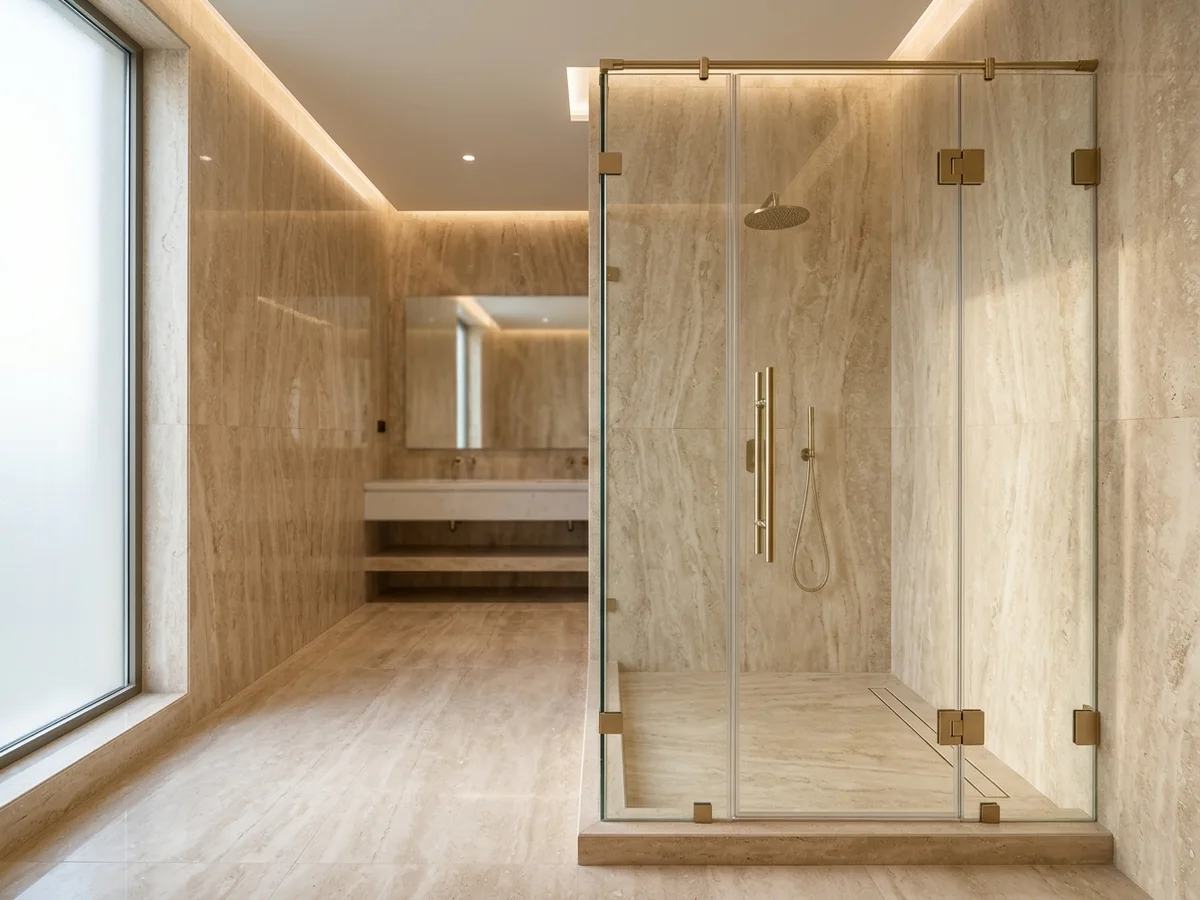
A door that turns on hinges like a room door gives a wide way in, but it needs space to swing. We explain swing direction, clearance, hinge positions and what to measure before a quote.
The short answer
A hinged glass shower door turns on hinges, inward or outward, and gives a wide entry close to the leaf width, but it needs room for the leaf to swing. Swing direction and hinge position are set against the bathroom layout before the glass is made, and hinge, hardware and finish options are confirmed on inquiry.
Direction comes down to two questions: does the leaf swing into the shower or out of it, and which side are the hinges on as you face the opening? The second is called the hinge side or handing, left or right. Doors are often set to open outward so the showering area stays clear, but that depends on bathroom space and hinge type; it is not a fixed rule.
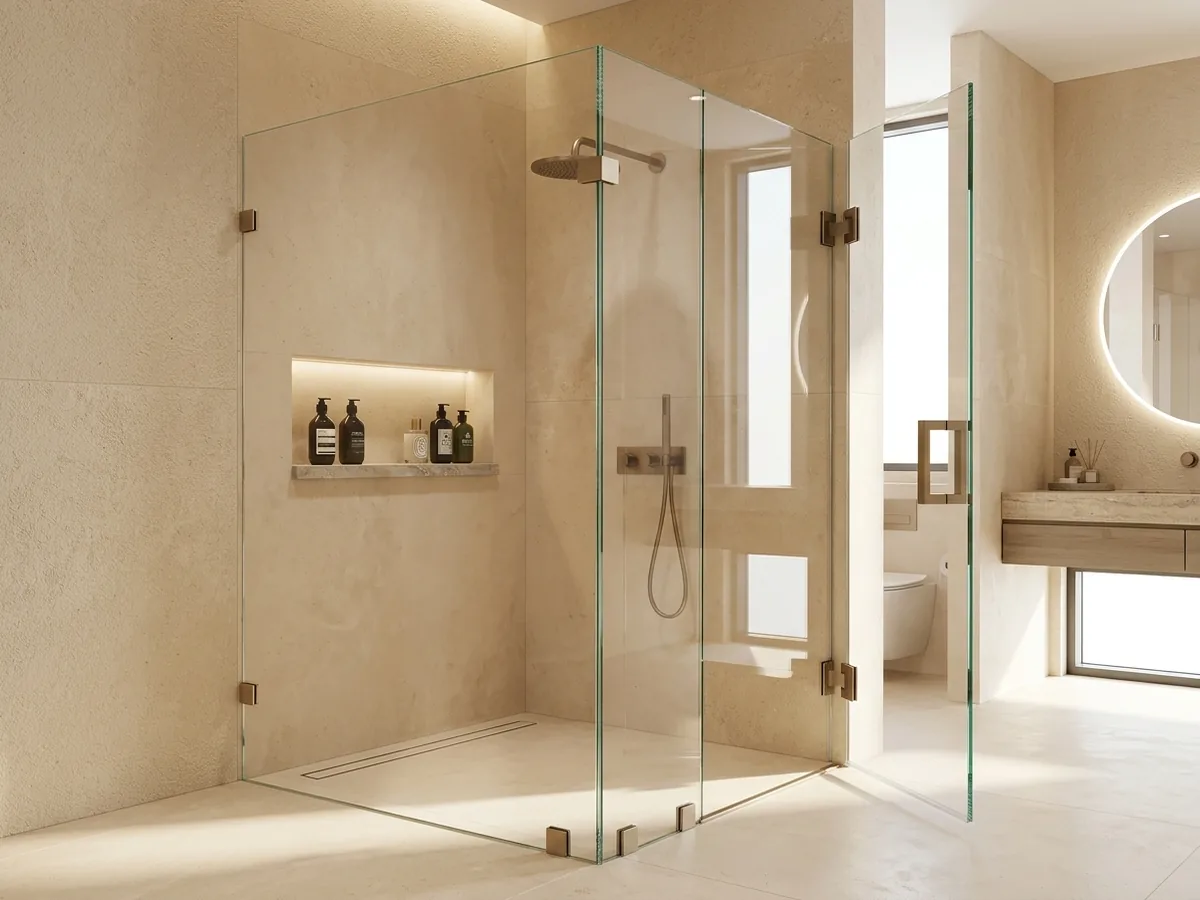
The concept image shows a corner shower with a partly open door and small clamps and hinges; it is a design concept only. In practice, stand at the opening and decide where you want the handle and which side is easiest to reach, since the handle sits opposite the hinges. Whether a door can open both ways is confirmed per hinge chosen.
No single direction is right for everyone; these are four common layout situations.
An outward-opening leaf may hit the vanity edge or cabinet. If the shower is roomy, opening inward may suit better.
Watch out for: Check tap projection and vanity height.
A toilet close by limits how far an outward leaf can swing. A partial angle may be enough to step in, but handle position and reach are checked.
Watch out for: The design may need a stop to set the swing angle.
If the bathroom door opens towards the shower, the two doors’ movements can cross. The hinge side is chosen so the two leaves do not meet.
Watch out for: Send a photo with the bathroom door open.
A towel rail or mixer in the leaf’s path prevents full opening. The item can be moved, or the hinge side changed.
Watch out for: This is settled before tempering, not after.
A general description of types; which are available, and in what finishes, is confirmed on inquiry.
It fixes to the wall on one side and the leaf on the other, so the wall carries a large part of the load. It needs a sound wall on the hinge side.
Watch out for: Wall and tile condition at the fixing point.
It joins the leaf to a fixed panel beside it, so the fixed panel and its fixing carry the weight instead of the wall. Common in enclosures with a fixed panel.
Watch out for: The fixed panel is part of the door’s support, not just decoration.
It follows the leaf’s weight, width and height, and hinges are spread over the height to ease stress on the glass. No fixed rule is assumed.
Some hinges may allow the leaf’s tilt to be adjusted or help it close. Whether that is possible is confirmed per available model.
A neutral comparison: each system has strengths, and the better one follows your bathroom, not a general rule.
| Aspect | Hinged shower | Sliding shower |
|---|---|---|
| Space | Needs clear space for the leaf to swing in or out | No swing space, but needs wall or fixed-panel length to slide along |
| Movement | A wide entry close to the leaf width when open | Entry through part of the width because the leaf stays in front of another panel |
| Appearance | Clean lines with visible hinges and handle and no floor track | The rail and rollers, overhead or bottom, are part of the look |
| Maintenance | Fewer moving parts; hinges and seals need periodic checking | The channel and rollers need regular cleaning |
| Installation requirements | A sound wall or fixed panel on the hinge side and accurate leaf alignment | A straight, level track with secure fixing for track and rollers |
| Practical points | Make sure the leaf cannot hit a vanity, door or towel rail | Suits tight entries, provided the real opening and track care are considered |
Choose Hinged shower
Choose hinged if there is enough room for the leaf to swing and you want a wide entry with fewer moving parts.
Choose Sliding shower
Choose sliding if space is tight or a swinging door would hit a fixed item, and you accept a partial opening and track care.
Neither system is always better. For how sliding works in detail, see the sliding shower page.
A photo showing the entry, vanity and bathroom door is enough to start, and the space each system needs can be reviewed from it.
Hinges and handles are small parts, yet they carry the door and shape daily use. All are options whose availability is confirmed on inquiry.
The wall that takes the hinges is the door’s anchor point. If it is out of plumb, weak, or covered in loosely bonded tile, the leaf’s tilt may shift over time. So wall type and tile condition at the fixing point are asked about before hinges are chosen. The image beside shows matte black hinges next to a double vanity, as a design idea only.
Closing sets everyday comfort and part of the splash control: rubber seals along the leaf edge and base, a handle that makes pulling easy, and a stop to prevent knocking the wall. These details reduce leakage rather than remove it, and the result also depends on shower-head position, floor slope and how the door is used.

Opening width
Measure width at the floor, midway and at the top. Readings differ if a wall leans, which matters especially for wall-mounted hinges.
Height
Measure from the tiled floor to the highest point the door should reach. A swing door is more sensitive to floor slope at its free edge than at the hinge side.
Swing side and direction
Stand facing the opening and note which side you want the hinges on, and whether the door opens in or out.
Wall straightness
Check the hinge-side wall with a spirit level and note any lean or cracking in the plaster or tile.
Clearance in front of the door
Measure from the opening to the nearest vanity, toilet, door or towel rail in the leaf’s path.
Tile completion
Finish tiling before the final measure if possible, as its thickness changes the opening’s dimensions.
No fixed or “from” price is published because cost depends on the details. Ask for the hinge and hardware specification to be written into the quote.
Send the opening width, height, preferred swing side and a bathroom photo, and the fit of a hinged door is reviewed before final sizes are set.
Questions about this service
There is no direction that is always best. Opening outward leaves the showering area clear, while opening inward may suit a roomy shower with a tight outside. The decision follows the vanity, toilet and bathroom door, so send a photo showing them.
In principle yes, provided there is clear space in front of the entry and the chosen hinge supports that direction. Available hinges are confirmed on inquiry, and the direction is settled before tempering.
Then the hinge side is reconsidered, the swing is limited with a stop, or a sliding shower is looked at since it needs no swing space. Send a photo with the door open so both paths are visible.
Hinges are part of the door and are normally visible, varying in size, shape and colour. A finish matching the handle and bathroom fittings can be chosen, with what is available confirmed on inquiry.
Not necessarily. With no bottom track to collect residue, cleaning is often easier, though hinges and rubber seals still need wiping and checking. What matters most is wiping after use and testing the closing from time to time.
It may be possible depending on the edge’s shape, levelness, width and whether it curves. This is reviewed from photos and measurements, and feasibility is confirmed after the site condition is considered.
Usually not easily, because hinge cut-outs in tempered glass are fixed before tempering and none can be added afterwards. So picture the movement first and confirm the side before the glass is made.
Four short steps prepare a clear WhatsApp message. Sizes are approximate, for inquiry only; final sizes are confirmed after technical verification.
Shower Glass
Compare sliding, hinged, fixed, corner, walk-in and frameless shower enclosures, plus sizing, hardware and pricing factors, before you request a quote in Taif.
Sliding Shower
Everything specific to sliding shower doors: track placement, door travel, the access opening, cleaning, hardware options, and the details to send for a quote.
Frameless Shower
Frameless does not mean fixing-free: understand the hinges, clamps, suitable layouts, design limits, and care of a frameless shower before you request a quote.
Sliding vs. Hinged Shower
Detailed comparison of sliding vs hinged glass shower doors covering bathroom layout clearance, water sealing, hardware, and maintenance in Taif.