Tayf Glass — Taif, Saudi Arabia
Tayf GlassARCHITECTURAL GLASS • TAIF
Architectural concept of large tempered glass panels separating an interior lounge from an olive-tree courtyard in a villa
Tempered glass guide

Tempered Glass in Taif: Custom Sizing & Installation for Your Project

Before you order a single panel, understand what changes in the glass after tempering and why dimensions, holes and edges must be final first. A practical guide for anyone planning partitions, doors, enclosures or glazed openings in Taif.

  • Stronger than ordinary glass, but not unbreakable
  • No cutting, drilling or edgework after tempering
  • Size is confirmed once the affecting finishes are complete
  • Thickness and system depend on the application and technical review
Design concept — not a completed project

The short answer

Tempered glass (known locally as securit) is heat-treated so it is several times stronger than ordinary glass of the same thickness, and when it breaks it crumbles into small granular pieces. It is not unbreakable, and it cannot be cut, drilled or edge-finished after tempering, so sizes, openings, edges and the fixing system are settled first. Send your Taif project details so the use and specification can be reviewed before anything is ordered.

What tempered glass is, and what it means for your order

Tempered glass is flat glass heated to a high temperature and then cooled in a controlled, rapid way. This locks stress into the pane, making it several times stronger than ordinary (annealed) glass of the same thickness against impact and thermal stress. That extra strength is why it is used where people handle glass every day, such as doors, partitions and shower enclosures.

The second benefit is how it fails. When fully broken, the pane crumbles into small, relatively blunt granules instead of the long, sharp shards ordinary glass produces. That does not make it unbreakable. A concentrated knock on an edge, an installation fault, or direct contact between the glass and metal or concrete without isolating material can break it, and a whole pane falling remains a hazard that must be planned for.

This has a direct practical consequence for your order. The stress locked inside the pane means it cannot be altered after tempering: no cutting, no drilling, no edge finishing. That is why this page keeps returning to one idea: every decision about dimensions, openings and edges is made before the pane goes into tempering, never after.

A note on terms: the Saudi market says “securit”, sometimes spelled differently in Arabic, while technical writing says tempered or toughened glass. They all refer to the same product. Laminated glass is a different build with different behaviour when it cracks, and it is compared further below.

Where tempered glass is used in homes and projects

Common uses, given to introduce the product. They are not a verdict that tempered glass suits every case; each application needs a technical review of the site and dimensions.

Glass doors

Hinged, sliding or framed doors are commonly specified in tempered panels, and their hinges and locks fix the positions of holes and cut-outs in advance.

Best for: Interior entries and room dividers

Watch out for: Exterior or wind-exposed use needs technical review, and the door type and hardware define the panel details.

Partitions and interior dividers

Panels that separate interior spaces while keeping light, either clear or with a finish that adds privacy.

Best for: Lounges, corridors and dining corners

Watch out for: Panel height and whether it is fixed at the floor, top or sides feed into the review of thickness and system.

Shower enclosures

One of the residential uses where tempered glass is most often specified, given daily moisture and contact. What matters here is that panel size and cut-outs are final before tempering.

Best for: Bathrooms measured after tiling is complete

Watch out for: Systems and hardware define the panel details and should be agreed before measurements are confirmed.

Interior glazing and openings

Fixed panels in interior openings, such as a viewing window between two rooms, can be requested in tempered glass depending on need and location.

Best for: Fixed interior openings

Watch out for: Some locations, such as panels near the floor or beside doors, may fall under Saudi Building Code requirements, and a qualified specialist decides what applies.

Large-scale architectural uses

Tall glass walls or point-fixed assemblies go beyond a simple partition and may use heat-treated glass within an engineered system.

Best for: Projects studied by an engineer before fabrication

Watch out for: These need engineering calculation and qualified review for loads, wind and fixing before any execution. Glass guards against falls are governed by the building code, need specialist design and are outside this page.

Glass options: clear, frosted, tinted and decorative finishes

These are options whose availability is confirmed on inquiry. They are not a list of ready stock.

  1. 01

    Clear

    The simplest visual choice, keeping light and a visual connection between two spaces.

    Best for: Partitions, doors and enclosures where openness is wanted

    Watch out for: It offers no privacy, and signs of use show clearly.

  2. 02

    Frosted

    Blocks the view partially or fully depending on the treatment, while light still passes.

    Best for: Places that need privacy with daylight

    Watch out for: The treatment type, its order relative to tempering and how easy it is to clean are confirmed for the finish requested.

  3. 03

    Tinted

    Reduces light and glare to a degree that depends on the colour chosen.

    Best for: Openings exposed to strong light

    Watch out for: Shades vary by source, so confirm the colour before ordering rather than after.

  4. 04

    Suitable decorative finishes

    Patterns, printing or fluted surfaces for privacy and appearance, depending on what is available for the project.

    Best for: Interior dividers with a design character

    Watch out for: Not every pattern or print suits heat treatment or every use, so the requested look is reviewed on inquiry.

Why panel size changes from one site to the next

A tempered panel is normally ordered for a specific opening rather than from a fixed size table. The final size is shaped by the opening type (door, partition or fixed panel), the system used (hinges, track or clamps), the hardware chosen, and the fixing requirements such as clearances and isolating material. Two neighbouring homes with the same design can therefore need different panels.

Then comes the effect of the site itself. Walls and floors are rarely perfectly straight, and tile thickness, plaster and installation gaps can change the real dimensions from those on the drawing. Because a panel cannot be adjusted after tempering, the size is confirmed once the finishes affecting the opening are complete, not from drawings alone.

Choosing the system is a decision that comes before the size is confirmed, not after. Hinges, tracks or clamps dictate hole positions and movement allowances. It is best to settle the door or partition type and the intended hardware before the panel size is confirmed, and if the system is still open it can be discussed when you inquire.

Edges, holes and cut-outs: all done before tempering

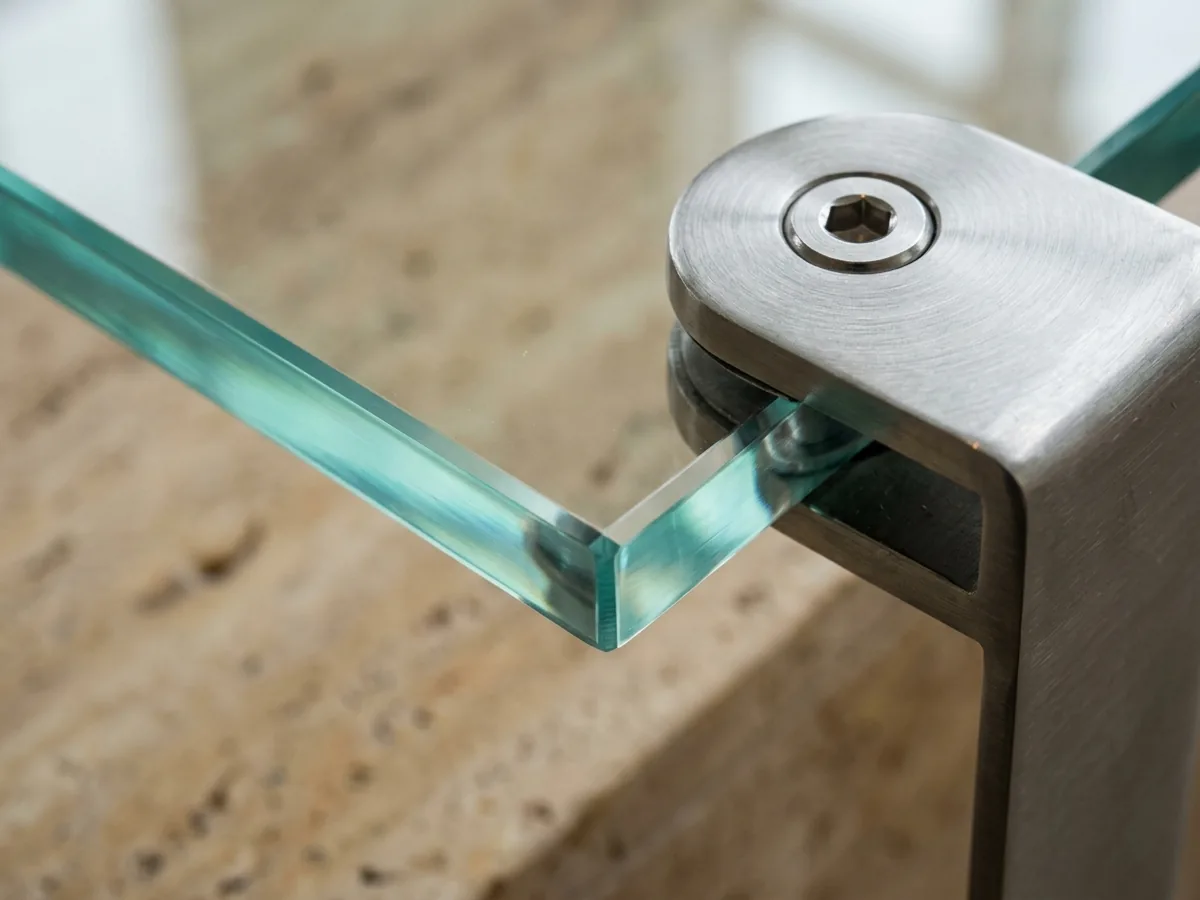
Processing the pane, meaning cutting, edge grinding and polishing, holes and side cut-outs, is done on the glass before it enters the tempering furnace, and tempering comes last. Edges matter especially, because a poor edge is a weak point in a pane that is under internal stress, so the required edge type is agreed before production. The image shows a concept of a polished, chamfered edge held in a clamp; it illustrates the idea and is not an approved specification.

Holes and cut-outs depend on the hardware: the size of a hole and its distance from the edge and from other holes are set by the hinge, clamp or lock chosen. A hole in the wrong place cannot be corrected after tempering; a mistake means a new panel. Name the hardware you intend to use and send any specifications or photos of it with your request.

Close-up of a polished, chamfered glass edge held in a brushed stainless clamp fixed with a hex socket screw
Design concept — not a completed project
Concept visual of an edge and clamp detail

Technical notes before you confirm an order

Tempered or laminated? A general comparison

A common question when planning any glass panel: is tempered enough, or is laminated needed? The answer depends on the use.

Tempered or laminated? A general comparison
AspectTemperedLaminated
BuildA single glass pane, heat-treatedTwo or more panes bonded with an interlayer
When it breaksCrumbles into small granules, and the pane or parts of it may fallLayers crack, but the interlayer generally holds the glass together
Common placesDoors, partitions, shower enclosures and interior openingsPlaces where the glass staying together after cracking matters, or where a specialist or the code asks for it
What is reviewed in the orderDimensions, holes and edges final before temperingLayer build-up, overall thickness and the supporting system

Choose Tempered

Consider tempered when the use suits a single pane, the dimensions are settled, and neither the site nor a specialist asks for something else.

Choose Laminated

Consider laminated when keeping the glass together after cracking matters for the use, or a specialist recommends it or the site requirements call for it.

This is a general comparison, not a rule; laminated glass is not required everywhere. Railings and glass guards against falls are governed by the applicable building code, need specialist design, and fall outside this page.

Have a use and an approximate size?

Send what you have about the opening, the use and the finish, and your project is reviewed for suitability before anything is fabricated.

What affects the price of tempered glass

Application and system
A door, partition or fixed panel, and the system and fixing each one requires.
Size and number of panels
Panel size and piece count affect quantity, handling and transport.
Specification
The glass type and the thickness the technical review arrives at, not a choice made in advance.
Finish
Clear, frosted, tinted or decorative, and the edge type required.
Hardware and fixing system
The hinges, tracks or clamps chosen, and the holes and cut-outs they require.
Complexity and installation conditions
The number of holes, cut-outs and special shapes, and how easy the installation site is to reach.

This page publishes no fixed prices. The price follows a review of your details, and it is wise for a written quote to state the specification and scope of work.

What to measure and send before ordering glass

At the inquiry stage, approximate sizes and photos are enough. These are not fabrication measurements.

  • The use

    A door, partition, fixed opening or enclosure, and whether it is interior or exterior.

  • Approximate opening size

    Approximate width and height, read at more than one point, noting any lean or unevenness.

  • State of the finishes

    Are tiling, plaster, flooring and paint complete? The final size is confirmed after them.

  • Intended hardware and hole positions

    The hinges, clamps or lock if known; hole and notch positions are then confirmed against its specification.

  • Finish wanted

    Clear, frosted, tinted or decorative, and the edge type if you have a preference.

  • Photos and location

    Photos of the opening from the front, side and above, plus the neighbourhood in Taif.

Send your project details to inquire about a quote

Send the use, approximate sizes and photos by WhatsApp or call, so project suitability can be reviewed and any missing information identified.

How an inquiry proceeds, step by step

  1. 1

    You send the details

    The use, approximate sizes, photos, the finish wanted and your neighbourhood in Taif.

  2. 2

    Suitability is reviewed

    The application, system and hardware are looked at, and points needing technical review are flagged.

  3. 3

    Final measurements are confirmed

    Once the affecting finishes are complete, and according to what is agreed for arranging a site visit.

  4. 4

    The specification is documented

    Size, edges, holes, finish and hardware are written into the quote before approval.

  5. 5

    The order is approved and next steps are coordinated

    After you approve the specification, supply and installation stages are coordinated. No timings are promised here; the schedule depends on the details after review.

Questions to ask before you approve an order

  • What glass specification is proposed (type, tempering, thickness) and on what basis was it chosen?
  • Will hole and notch positions and the edge type be documented in the quote before tempering?
  • Which hardware and fixing system are needed, and are they accounted for with the panel?
  • What happens if a size error is found, and at which stage is it cheapest to catch?
  • How is the rare possibility of spontaneous breakage handled on my project?
  • Does my use or location need a specialist review or code requirements?

Questions about this service

Frequently asked questions

Is tempered glass unbreakable?

No. It is several times stronger than ordinary glass of the same thickness, but it can still break, especially from a concentrated knock on an edge, an installation fault, or contact with metal or concrete without isolating material. Its advantage is that it breaks into small, relatively blunt granules. A whole pane falling remains a hazard to plan for.

Can tempered glass be cut or drilled after tempering?

No. The internal stress in a tempered pane means any cutting, drilling or edge grinding afterwards can make it shatter. These operations are done on the glass before tempering, so dimensions, hole positions and edges are settled in advance. If an error shows up after tempering, the usual remedy is a new panel, not a modification.

Why am I asked to wait for finishes before the final size?

Because tiling, plaster, paint and floor levelling can change the real opening by small amounts, and a tempered panel cannot be adjusted once made. It is safer to measure after everything affecting the opening is complete, then confirm the size. You can still inquire early with approximate sizes that are not used for fabrication.

What is the difference between “securit” and “moqassa”?

There is no difference in the product. “Securit” is a common trade name in the Saudi market, while “moqassa” (tempered or heat-toughened) is the technical description of heat-treated glass. Both differ from laminated glass, which is two or more panes bonded with an interlayer, compared with tempered glass in the section above.

Can ordinary glass I already have be tempered?

Each case is considered individually and nothing is promised. The review looks at the glass type, condition and thickness, and whether its edges, holes and dimensions are already final, since tempering is not done on a pane that will need alteration afterwards. Often ordering a new panel to specification is clearer. Send photos and sizes for review.

What information do I need for a quote?

The use (door, partition, opening or enclosure), approximate opening sizes, photos from several angles, the finish wanted, the intended hardware if known, whether finishes are complete, and your neighbourhood in Taif. The initial review identifies anything missing.

Is frosted glass tempered too?

Frosting and tempering are separate properties, so a pane may be both, or only one. State clearly in the request that the pane must be tempered, and the type of treatment and its order relative to tempering are confirmed for the finish requested, along with its availability, on inquiry.

What thickness of tempered glass is right?

No single thickness suits everything, which is why this page gives no figures. Thickness is set by the application, panel dimensions, fixing method, location and the approved specification, and reviewed by a specialist. If you find a ready-made figure elsewhere, do not rely on it for your project without review.

Send your project details to inquire about a quotation

Four short steps prepare a clear WhatsApp message. Sizes are approximate, for inquiry only; final sizes are confirmed after technical verification.

Related services & guides

Call NowWhatsApp